
Vol. 18.1-2 (2018): Pacifism and Nonviolence as Philosophical Mandate

Vol. 18 opens with a declaration: pacifism and nonviolence are not marginal or naïve positions but the core of a robust philosophical tradition deserving serious, sustained engagement. The editor’s introduction notes a small but telling coincidence — around 2014–2015, Andrew Fiala was negotiating the title of what would become The Routledge Handbook of Pacifism and Nonviolence, and in March 2016 The Acorn‘s editors were revising the journal’s own subtitle, both projects landing independently on the same terms. A zeitgeist was at work. Fiala supplies the epigraph for the volume: students sympathetic to pacifism routinely write things like “I’m not really a pacifist, but I think that war is wrong” — a confusion that leaves people unable to clearly affirm what they actually believe. The issue sets out to name the tradition clearly and to argue for its philosophical seriousness across every section.

Andrew Fiala’s lead article, “The Pacifist Tradition, and Pacifism as Transformative and Critical Theory,” makes the systematic case. Against the standard move of defining pacifism as an absolute, dogmatic rejection of all violence — a straw man that is easy to dismiss — Fiala argues that pacifism is best understood as a family resemblance tradition analogous to feminism: a long global conversation, normatively affirmative in character, whose core claim is that peace is an end-in-itself and that nonviolent means are the preferred path toward it. The pacifist canon is wide — Jesus and the Buddha, Erasmus, Tolstoy, Gandhi, Jane Addams, Dorothy Day, King, Thich Nhat Hanh, the Dalai Lama, Robert Holmes — and the tradition interweaves Western, South Asian, East Asian, Islamic, and indigenous sources in ways that standard social and political philosophy has largely ignored. Fiala situates the tradition beside the just war tradition as its historical interlocutor, argues that justice, liberty, equality, and happiness are each best understood within a framework organized around peace, and insists that admitting rare exceptional cases for violence does not defeat the tradition’s core project — which is not primarily about exceptional cases but about transforming the world to reduce them. Steven Steyl’s “What Can Virtue Ethics Offer Pacifists?” takes a complementary approach from within Aristotelian ethics, a tradition that has long been hospitable to war and largely hostile to pacifism. Steyl translates a pacifist argument from suffering into an argument from the virtue of compassion: a genuinely compassionate agent, sensitive as she is to others’ suffering, will be profoundly averse to lethal warfare. But a single-virtue argument cannot by itself constitute a complete pacifism, because the virtues are generally held to be unified and reciprocal — an agent with genuine compassion should also have the courage and practical wisdom to recognize when force is needed. The more serious obstacle is the impracticality objection: a compassion-based pacifism will seem to leave the innocent undefended. Steyl maps two avenues available to the virtue ethicist in responding to this objection, finds neither fully developed in the current literature, and calls for further scholarly work — framing the article as an opening of a research program rather than a conclusion.

The issue’s feature section pairs two very different kinds of tribute. Tommy Curry’s The Man-Not: Race, Class, Genre, and the Dilemmas of Black Manhood won the American Book Award, and Vol. 18 memorializes an Author Meets Critics session hosted by the Society for the Advancement of American Philosophy at its 2018 meeting in Indianapolis. The book’s central argument — that Black men and boys occupy the position of “outgroup-alien males” in patriarchal societies, targeted not for coercion and control but for extermination and social ostracization — draws on social dominance theory and global masculinities research to challenge what Curry sees as intersectionality’s failure to account empirically for the distinct targeting of Black males. Critic Anthony Neal argues that the book does what no other recent text on Black males has done as well: it refuses to simply cite negative statistics and instead catalogues the conditions that produce them, making dehumanization visible as a structured outcome rather than a cultural given. Critic Dwayne Tunstall frames the book as a call to repentance — a demand that US academia forsake its “anti-Black racist misandry” and learn to care about Black men and boys as persons rather than as objects of study or spectacle. The editor notes that as the introduction was being written, Curry was taking a position at the University of Edinburgh — a departure that, given the cultural logic the book describes, the introduction quietly marks as a kind of exile. Duane Cady’s “Remembering Mulford Q. Sibley (1912–1989)” offers a warm, personal, 30-year commemoration of the iconoclastic Quaker pacifist and political theorist who taught at the University of Minnesota for four decades, served as faculty advisor to the Student Peace Union during the McCarthy era, and edited The Quiet Battle, the canonical anthology of nonviolent resistance that circulated among Vietnam War resisters. Cady’s recollections bring Sibley alive — the red tie he adopted as a permanent rebuke to red-baiters, the letter to the student newspaper calling for a campus communist professor, a “Society for the Promotion of Free Love,” and a “Nudist Club” to make clear that the real issue was academic freedom, not communism. Cady first met Sibley in 1972, studied with him at a 1983 NEH summer seminar on utopian literature, and credits Sibley’s encouragement with leading to his first publication.

Six reviews carry Vol. 18’s argument outward into film, activism, philosophy of war, climate theory, music, and literature. Arnold Farr reads Ryan Coogler’s Black Panther film through two competing moral frameworks: the Standard Morality Reading, in which T’Challa is the hero upholding nonviolence, order, and tradition, and the Liberation Morality Reading, in which Erik Killmonger — a product of racial oppression rather than its cause — functions as the conscience of Wakanda, forcing its comfortable citizens to confront the suffering of Black people outside its borders. Farr finds the film genuinely dialectical, with Killmonger raising the question of who gets to define violence when structural oppression is itself a form of it, and ends with skepticism that the sequel will sustain the liberation-philosophical tension rather than reverting to a villain-from-outside plot. Court Lewis reviews Howard Caygill’s On Resistance, which begins with Clausewitz to argue that the philosophy of war is, paradoxically, an illuminating resource for understanding nonviolent resistance — offering, Lewis concludes, “a rubric by which to measure the nature of resistance, whether to understand it as a mere reaction to an event or situation, or to understand it as a means to correct abuses in order to instill positive and lasting changes.” Tom Hastings reviews two books from what he treats as revered Quaker elders: Staughton and Alice Lynd’s third edition of Nonviolence in America: A Documentary History (Orbis, 2018), which now includes documentation of Veterans for Peace joining indigenous resistance to the Dakota Access Pipeline, and George Lakey’s How We Win (Melville House, 2018), a comprehensive guide to nonviolent direct action from a practitioner Hastings calls “a nonviolence training mentor to many.” Walter Kendall reviews Bruno Latour’s Down to Earth, which frames the climate crisis as a failure of political imagination: the standard right-left binary leaves both sides sharing the nation-state presuppositions that make the crisis intractable, and Latour argues for a “Territorial” rather than “Modern” orientation as the necessary conceptual precondition for addressing it — a theoretical preparation, Kendall argues, for evaluating the recently proposed Green New Deal. Finally, Court Lewis reviews two very different books together: Dario Martinelli’s Give Peace a Chant, which classifies Songs of Social Protest by their Umwelt relations, lyrical types, and musical types, recovering the embodied and affective dimensions of nonviolent resistance that political philosophy tends to neglect, and William Irwin’s Little Siddhartha, a philosophical novel that takes up the story where Hesse left off — a “jewel of philosophical literature,” Lewis writes, that invites readers into reflection as their fears of pacifism and nonviolence “take an overdue respite.”
Vol. 17.2 (Fall 2017): Hard Cases, Kantian Guns, and the Legacy of Gene Sharp

Vol. 17.2 picks up where the previous issue left off in the philosophy of nonviolence and pushes directly into the hardest terrain: the cases where intuition most powerfully resists pacifist conclusions. Both articles argue from within the Western philosophical tradition — Tolstoy and Kant respectively — that nonviolence is philosophically defensible even when the stakes are highest, and the issue closes with two memorial tributes to Gene Sharp, who died on January 28, 2018, two days before the anniversary of Gandhi’s assassination. Taken together, the issue stages a sustained argument that the philosophical foundations of nonviolence are more secure, and more demanding, than either its opponents or its pragmatic defenders tend to acknowledge.

Charles Fink’s “Nonviolence and the Hard Question” takes Tolstoy’s canonical challenge seriously rather than dismissing it — the case of an innocent child threatened by a violent criminal, where killing the attacker seems to be the only option. Fink does not argue that pacifism is obligatory in this case, but that it is at least permissible — and that this more modest conclusion is less trivial than it sounds, since pacifists are routinely accused of cowardice or selfishness precisely for refusing to kill in defense of others. His argument proceeds on three fronts. First, the consequentialist case for defensive killing is shakier than it appears: we cannot know with certainty what the consequences of either action will be, and Tolstoy’s point that killing the criminal is certain while the child’s death is not has more force than our intuitions typically allow. Second, attempts to define violence narrowly enough to permit defensive killing — as retaliation only, or as harm wished for its own sake — fail, because killing someone as a means to an end still treats that person as a mere thing, violating their dignity as surely as any act of malice. Third, and most positively, if it is at least permissible to cultivate agapeic love — the boundless, impartial love that cannot simultaneously wish harm on anyone — then it is at least permissible to commit oneself to nonviolence in every circumstance. Fink draws on the Buddha’s Metta Sutta, the Bhagavad-Gita, and the Sermon on the Mount to show that the ideal of agapeic love is not the exclusive property of any tradition, and that those who would compel us to commit violence in defense of the innocent are implicitly insisting that unconditional love is a moral failing — a conclusion he finds plainly absurd. Matthew Rukgaber’s “Guns as Lies” approaches the question from a different angle, mounting a Kantian argument that guns, like lies, are evil in themselves regardless of the costs and benefits they produce. Kant’s controversial claim is that lying is reprehensible even when it harms no one, because it corrupts practical reason itself — it makes truth a mere means to be used rather than a constraint to be obeyed, erodes character, and ultimately destroys the foundation on which all rights and contracts rest. Rukgaber argues that bearing lethal arms does the same kind of moral damage: guns are not merely dangerous objects but machines with their own normative and material teleology, one that requires the bearer to arrogate to themselves the power of violent enforcement — a power that in a civil society properly belongs only to the collective. Just as lying places individual judgment above the “common authority as the proper enforcer of rights,” so gun ownership constitutes a standing declaration that one wills to live in a community where violent self-help is the operative standard. This structural moral objection, Rukgaber argues, operates independently of any empirical assessment of risk and places a significant burden on any advocate of gun rights to show that the benefits outweigh not only the physical harms guns produce but the moral distortions they require.

Three book reviews carry the issue’s global reach outward in three directions. Bill Gay reviews Todd May’s Nonviolent Resistance: A Philosophical Introduction (Polity Press, 2015), finding it a commendable and accessible introductory text whose core contribution is a taxonomy of four nonviolent strategies: Gandhi’s satyagraha, which seeks to persuade and then to dramatize injustice through willingness to suffer; the “moral jiu-jitsu” of Richard Gregg; the “political jiu-jitsu” of Gene Sharp’s tradition, which exploits the dependence of governments on popular compliance; and the decentralized occupation-based experiments of Occupy and Critical Mass. May roots all four in the values of dignity and equality, drawing largely on Kant for the former and Jacques Rancière for the latter. May’s final chapter on neoliberalism as structural violence — arguing that the appropriate nonviolent response is to undermine rather than overthrow the neoliberal order — is, Gay suggests, one of the book’s most distinctive and timely contributions. Gay notes some gaps, including May’s failure to engage The Acorn and Concerned Philosophers for Peace literature, and his occasional conflation of pacifism with passivism. Sanjay Lal reviews the two-volume anthology Nonviolence as a Way of Life (Motilal Banarsidass, 2017), edited by Predrag Cicovacki and Kendy Hess, which brings together fifty-four contributors from twelve countries and five continents under the rubric of the Jain concept of ahimsa. Lal identifies the collection’s greatest strength as its breadth — chapters range from Jain studies proper (Donaldson on environmental rites, Fisher on the 1947 Partition) to everyday applications in prisons, parenting, medicine, and environmental ethics — while also noting its unevenness, singling out Apressyan’s “The Limits of Nonviolence in Reactive Action” for failing to engage the Gandhian means-ends literature and thus arriving too quickly at a conclusion that violent responses are sometimes justified. He offers sustained praise for contributions by Barry Gan, Robert Holmes, and Johan Galtung, whose pieces collectively make the philosophical case that violence is not basic to human nature and that nonviolence is a continuum rather than a binary. Court Lewis reviews Chaiwat Satha-Anand’s Nonviolence and Islamic Imperatives (Irene Publishing, 2017), a collection of essays written over thirty years that argues Islam’s core values require nonviolence and that the association of Islam with terrorism represents a profound misreading of Islamic history. Satha-Anand’s anchoring move is to reframe September 11 — not as 2001 but as 1906, when Muslim leader Sheth Haji Habib supported Gandhi and helped bring his South African satyagraha movement into existence — and to derive from the Qur’an and Prophetic Traditions five pillars of nonviolent peacemaking: willingness to disobey unjust laws, courage before evil, discipline, community, and constructive action. Lewis recommends the book to anyone seeking a deeper understanding of Islamic history and practice, noting that its insights are valuable to Muslims and non-Muslims alike.

The issue closes with two memorials for Gene Sharp. Barry Gan, former editor of The Acorn, recalls Sharp as a figure who shifted the field of nonviolence decisively toward its pragmatic and political dimensions, deliberately separating strategic nonviolence from the metaphysical and ethical framework in which Gandhi had embedded it. Gan traces Sharp’s intellectual development from early Gandhi scholarship through the magnum opus The Politics of Nonviolent Action (1973) and the later From Dictatorship to Democracy, translated into thirty-one languages and used by activists across the Arab Spring and the former Soviet republics. Gan offers personal memories of Sharp speaking at the Rochester Zen Center in the late 1980s and at an Oxford conference in 2007 — “almost shy, certainly affable” in small settings, “comfortable and expansive” at the podium. Gan’s one note of puzzlement is Sharp’s determination to emphasize the political and ignore the ethical in Gandhi, a separation that Gan, as a philosopher of pacifism, never quite accepted. Jack DuVall, co-author of A Force More Powerful and longtime collaborator with Sharp’s tradition, offers a complementary portrait, calling Sharp “a general of ideas” who built the roads before commerce could travel them. DuVall suggests that the absence of overt moral framing in many Sharp-influenced movements may be less significant than it appears: Vaclav Havel’s insistence that nonviolent resistance means “living within the truth” points to an implicit moral dimension that operated even where explicit ethical commitment was absent. Together the two tributes frame Sharp’s legacy as genuinely open — the colloquy between principled and pragmatic nonviolence that his life’s work provoked is, DuVall writes, “open-ended,” and the rights and freedom of all of us may yet depend on how it continues.

Vol. 17.1 (Spring/Summer 2017): Cosmopolitanism, Consciousness, and the Climate of Resistance

The editor’s introduction to Vol. 17.1 frames the issue as a kind of chiasm — four features paired thematically with four book reviews, with Anthony Neal’s Author Meets Critics session at the center. The bookends are cosmopolitan in orientation: Corey Barnes draws upon Alain Locke to argue that normative cosmopolitanism and liberal neutrality are compatible rather than in tension. For Barnes, the apparent impasse dissolves once we recognize that the core democratic values Locke identifies — liberty, equality, and fraternity — are not merely political preferences but the fundamental presuppositions of any free association whatsoever. A state committed to pluralism need not remain neutral about the values that make pluralism possible in the first place; it need only remain neutral about any conception of the good that does not violate those foundational associative values. The result is a Lockean case for cosmopolitan obligation that does not require prior cosmopolitan commitment from the reader.

The two remaining articles address the personal and civic dimensions of nonviolent commitment. Sanjay Lal’s “Affirming a Vital Connection” takes up a question peace theorists have largely left to academic philosophy: whether death is a harm to the one who dies, and what hangs on the answer for nonviolent practice. Drawing on Epicurus, Epictetus, and Marcus Aurelius — and finding an unexpected ally in Gandhi — Lal argues that disavowing death as the greatest evil is not merely compatible with a fully engaged moral life but essential to it. The standard objection, pressed by Steven Luper, is that adopting an Epicurean attitude toward death would produce coldness and passionlessness, since it requires indifference to the thwarting of our deepest desires. Gandhi’s life is Lal’s counter-evidence: what Gandhi’s fearlessness toward death actually required was not indifference to life’s projects but a reorientation of priorities — away from external goods toward the internal harms of fear, anger, and moral failure, which Gandhi regarded as the only evils truly within our power to avoid. John Nolt’s “Anger, Despondence, and Nonviolence” begins in his environmental ethics classroom at Tennessee the morning after the election — smoke from the Great Smoky Mountain fires visible from his office window, students shaken — and moves outward to the April 2017 People’s Climate March in Washington. Nolt’s argument is autobiographical and practical: despondence is often unexpressed anger, anger is better than withdrawal, and nonviolence is the discipline that transmutes the energy of anger into sustained action rather than impulsive reaction. His account of the 1969 Vietnam Moratorium and the five years that separated it from the U.S. withdrawal offers activists a long view of what marches accomplish, and his closing injunction — “Get active. Vote. Teach. Live sustainably. Organize.” — doubles as the issue’s own political address to its readers.

The Author Meets Critics forum centers on Anthony Neal’s Common Ground (Africa World Press, 2015), which brings Howard Thurman and Huey Newton into philosophical dialogue as two figures working within the Modern Era of the African American Freedom Struggle who reached opposite conclusions about the source and nature of consciousness. For Thurman, consciousness is grounded in the mind of God disclosed through nature and mystical experience; for Newton, consciousness is a property of the material world, shaped by the violent contradictions of urban Black life and best analyzed through Marx. The session was hosted at the 2016 Philosophy Born of Struggle Conference under the direction of Tommy Curry. Critic Dwayne Tunstall engages Thurman’s phenomenology directly, proposing that what Thurman is doing is better described as “conjuring phenomenology” — not disclosing features of Being but constituting a healing social vision through language and symbol, in the tradition of Theophus Smith’s analysis of African American conjure culture. Tunstall’s challenge to Neal is whether Thurman’s account of Being as inherently life-affirming can survive the life-denying disclosures of slavery, Jim Crow, and ongoing anti-Black violence. Critic Felipe Hinojosa widens the aperture considerably, situating the Thurman-Newton comparison within a colonial history that includes Latin America and the Caribbean from 1898 onward, and arguing that the revolutionary consciousness both figures cultivated was not confined to the Black-white racial binary but intersected with Latinx struggle throughout. Neal’s responses affirm both readings and leave the question between Thurman’s spiritual and Newton’s materialist paths deliberately open, in the spirit of Platonic dialogue — the reader is invited into the debate rather than handed a resolution.

Four book reviews complete the issue. Rick Werner reviews Robert Holmes’s Pacifism (Bloomsbury, 2017), finding it the most complete and compelling philosophical case for pacifism yet written. Holmes’s central argument is that whole wars — the totality of a conflict across all parties — are presumptively wrong because at least one side in any justified partial war is necessarily fighting unjustly; the burden of proof to overcome that presumption cannot be met in practice so long as nonviolent alternatives exist, and he demonstrates at length that they do. Sanjay Lal reviews Andrew Fitz-Gibbon’s Talking to Terrorists, Nonviolence, and Counter-Terrorism (Palgrave Macmillan, 2016), which draws on the Northern Ireland peace process — specifically the decision of Catholic and Loyalist leaders to open dialogue with those responsible for terrorist acts — to propose a rough but viable road map for progress in the Israeli-Palestinian conflict. Lal finds the book’s philosophical implications richer than Fitz-Gibbon fully develops: the Northern Ireland example suggests that even radical forgiveness may be morally required of victims, and that fruitful negotiations need no dominant moral exemplar to succeed. Bat-Ami Bar On reviews David Miller’s Strangers in Our Midst (Oxford University Press, 2016), a philosophically sophisticated defense of principled, restrictive immigration policy framed by weak cosmopolitanism, national self-determination, fairness, and social integration. Bar On finds Miller’s realism useful for anyone trying to engage seriously with objections to open borders, but reports that the book’s argumentative complexity — its sustained engagement with opposing positions in every chapter — made it difficult to teach, a limitation she notes with some reluctance given how urgently its arguments are needed. Court Lewis reviews Eddy Souffrant’s edited collection A Future without Borders? Theories and Practices of Cosmopolitan Peacebuilding (Brill-Rodopi, 2016), which examines how state violence and the border regimes that sustain national identity are structurally entangled, and what cosmopolitan alternatives to that entanglement might look like in practice — a fitting close to an issue that opened, with Barnes, by asking what cosmopolitanism is owed and why.

Vol. 16.1–2 (Fall/Winter 2016–2017): The Acorn in Transition

Vol. 16 arrived with work to do: published as a double issue, it marked the journal’s relocation to Texas State University at San Marcos and the formal beginning of Greg Moses’s editorship. It opened with a “Transitions” section — an editorial note explaining the handover from Barry Gan, who had received the journal from founding editor Ha Poong Kim, followed by three vision statements from Gan, Sanjay Lal, and Moses reflecting on what the journal should mean and where it should go. Gan’s statement argued that what distinguished the journal’s exemplars was their uncompromising refusal of violence as a means to peace — that using violent means implicitly endorses a principle opposed to peace, moving us further from Kant’s kingdom of ends and King’s beloved community, and that The Acorn should continue examining these questions with philosophical rigor. Lal’s statement called for philosophy to hold a prominent place within Peace Studies alongside its empirical work, arguing that questions about moral worth, the rationality of nonviolent response, and the cultivation of nonviolent character are precisely where philosophical expertise is most needed — and that the journal’s exemplars themselves demonstrate philosophy’s indispensable connection to practical action. Moses’s statement cast the journal’s mission in explicitly epistemological terms: philosophical concepts must remain open to choice, and The Acorn is devoted to inquiry that actively chooses in the direction of peace, welcoming divergent definitions, new logics, and conceptual paths “we never imagined.” The issue also introduced the renamed Gandhi, King, Chavez, Addams Society (GKCAS), adding Cesar Chavez and Jane Addams to the society’s roster of exemplars, and marked the new subtitle: Philosophical Studies in Pacifism and Nonviolence. Two bibliographies — Marilyn Fischer’s essential bibliography of Jane Addams’s writings on peace, and Orosco’s bibliography of Cesar Chavez — signaled the expanded scope of the journal’s intellectual community.

The features section ranged across striking terrain. Orosco contributed a substantial article, “Abolition as a Morally Responsible Response to Riots,” drawing on King’s and Chavez’s responses to structural violence — prompted in part by the 2015 Baltimore uprising — to argue that a genuine nonviolent response to urban unrest begins not with moral condemnation of rioters but with interrogating the economic and cultural conditions that generate uprisings in the first place. Gan offered a version of his keynote address for the United Nations celebration of the International Day of Non-Violence (October 2, 2016), hosted by the Permanent Mission of India to the U.N., titled “Seeds of Duty,” which returned to Gandhi’s insistence that duties precede rights — that a politics grounded in duty toward others is more generative than one centered on rights claims. Gail Presbey reported from the 2016 World Social Forum in Montreal, where participants from across the Global South debated decolonizing knowledge, capitalist extraction, and the limits of the WSF’s own consensus model.

The Author Meets Critics forum centered on Predrag Cicovacki’s book Gandhi’s Footprints, with critics Sanjay Lal and Carlo Filice. Cicovacki opened by framing a central paradox: Gandhi is universally revered but rarely emulated. His resolution — that Gandhi’s vision can be followed without being imitated, particularly his insistence on spiritual grounding within a materialistic world — was pressed by both critics. Lal argued that the transformative depth of Gandhi’s spiritual aspirations should not be softened into conventional wisdom. Filice asked how Cicovacki’s account could handle the tension between Gandhi’s commitment to unified reality and the apparent distinction between spirit and matter, and whether Gandhi’s nonviolence could accommodate principled exceptions. Cicovacki replied by turning to Tagore’s influence on Gandhi.

Three book reviews rounded out the issue. Tom Hastings reviewed War No More: Three Centuries of American Antiwar and Peace Writing (ed. Lawrence Rosenwald), praising it as the essential text for courses in American peace history and noting its central revelation: that the United States has a long, pluralistic, and largely hidden tradition of antiwar thought stretching from pre-colonial Indigenous peacemakers through the present — far richer and more racially diverse than standard history texts acknowledge. Sanjay Lal reviewed Anuradha Veeravalli’s Gandhi in Political Theory: Truth, Law, and Experiment, finding that Veeravalli makes a significant contribution by demonstrating how Gandhi’s non-dualistic framework — his insistence on the unity of means and ends, theory and practice — offers a rigorous alternative to the post-Enlightenment dualisms that underlie modern violence, though Lal presses on tensions in Veeravalli’s handling of Gandhi’s asceticism and brahmachari experiments. Court Lewis reviewed Sara Trovato’s Mainstreaming Pacifism: Conflict, Success, and Ethics, whose central argument — that Machiavelli’s concept of effettualità can be redeployed to show that “lower” effectual forms such as dialogue, ideals, and vulnerability are just as politically effective as fraud and force — Lewis found both original and strategically useful, since it defends pacifism on pragmatic grounds that do not require prior ideological commitment from the reader. The issue closed with an afterword written in the weeks following the 2016 U.S. election, connecting Gandhi, King, Chavez, and Addams to the political urgency of the moment and affirming that this heritage of nonviolent resistance remained “eminently worthy of study and reflection.”

Our Publication Ethics

The Acorn: Philosophical Studies in Pacifism and Nonviolence insists on ethical behavior from its editors, reviewers, and authors. Our policies are closely aligned with COPE’s (Committee on Publication Ethics) Core Practices.

Any cases of ethical misconduct will be treated very seriously and will be dealt with in accordance with COPE guidelines.

Materials published in The Acorn fall under the categories of Features, Reviews, or Articles. Features and Reviews may be submitted by authors or invited by the editorial team subject to final editing. Articles follow the formal processes of peer-review as set forth below:

1. Responsibilities of the Editorial Team

Publication decisions

The Editor is responsible for deciding on initially accepting, rejecting, or requesting modifications to the manuscript. After initial acceptance, article submissions will be circulated for anonymous peer review in accordance with our Submissions guidelines and practices. The Editor reserves the right to edit, clarify, or shorten manuscripts as deemed necessary.

Fair review

All editors and editorial staff must ensure that each manuscript submitted to The Acorn is reviewed for its intellectual content without regard to the author’s race, gender, sexual orientation, religious belief, ethnic origin, citizenship, or political philosophy. The decisions will be based on the paper’s importance, originality, clarity, and relevance to the journal’s scope.

Confidentiality

Information concerning a submitted manuscript should only be revealed to the corresponding author, reviewers, editors, Associate Editors, or Editorial Board members, as is required or otherwise appropriate.

Disclosure and conflicts of interest

The editors and editorial staff shall not use unpublished materials disclosed in a submitted manuscript for his/her own research without the author’s explicit written consent. Editors, including Associate Editors and the Editorial Board, will recuse themselves from considering manuscripts in which they have conflicts of interest resulting from competitive, collaborative, or other relationships/connections with any of the authors, companies, or institutions connected to the papers.

2. Responsibilities of Reviewers

Purpose of peer review

The peer review process is a crucial component in helping the editor and/or editorial board reach editorial or publishing decisions and may also serve the author in improving the quality of the submission.

Promptness

A potential reviewer should withdraw from the review process if he/she feels unqualified to assess the contribution or cannot provide an assessment in a timely manner as defined by the editor.

Confidentiality

Manuscripts for review must be considered confidential documents. Information concerning the manuscripts should not be discussed with others without the approval of the editor.

Disclosure and conflicts of interest

Reviewers will not use unpublished information disclosed in a submitted manuscript for their own research purposes without the authors’ explicit written consent. Reviewers will recuse themselves from considering manuscripts in which they have conflicts of interest resulting from competitive, collaborative, or other relationships/connections with any of the authors, companies, or institutions connected to the papers.

Objectivity

Reviewers should strive to be objective in their assessments. Reviewers’ comments should be clearly expressed and supported by data or arguments. Personal criticism of the author(s) is not appropriate.

Acknowledgment of sources

Reviewers should identify relevant published work that has not been cited by the authors. Any statement that an observation, derivation, or argument had been previously reported should be accompanied by the relevant citation. A reviewer should also call to the editor’s attention any substantial similarity or overlap between the manuscript under consideration and any other published paper of which they have personal knowledge.

3. Responsibilities of the Author

Reporting standards

Authors are solely responsible for the content and accuracy of their articles. That is, the authors are responsible for ensuring the research was conducted in an ethical manner, data were collected and analyzed by employing appropriate scientific methods and interpreted accurately. A paper should contain sufficient detail and references to permit others to replicate the work. Fraudulent or knowingly inaccurate statements constitute unethical behavior and are unacceptable.

Data access and retention

As a philosophical journal, The Acorn is not at this time engaged with data analysis; however, if data analysis becomes a part of the journal’s concern, we will update our guidelines to require appropriate repository archives.

Originality, plagiarism, and acknowledgment of sources

Authors will submit only entirely original works and will appropriately cite or quote the work and/or words of others. Publications that have been influential in determining the nature of the reported work should also be cited. Information obtained privately, as in conversation, correspondence, or discussion with third parties, must not be used or reported without explicit, written permission from the source. Information obtained in the course of confidential services, such as refereeing manuscripts or grant applications, must not be used without the explicit written permission of the author of the work involved in these services.

Multiple, redundant, or concurrent publication

In general, papers describing essentially the same research should not be published in more than one journal. Manuscripts which have been published as copyrighted material elsewhere cannot be submitted.

Authorship of the paper

Authorship should be limited to those who have made a significant contribution to the conception, design, execution, or interpretation of the reported study. All those who have made significant contributions should be listed as co-authors. Where there are others who have participated in certain substantive aspects of the research project, they should be acknowledged or listed as contributors. The corresponding author should ensure that all appropriate co-authors and no inappropriate co-authors are included on the paper, and that all co-authors have seen and approved the final version of the paper and have agreed to its submission for publication.

Disclosure and conflicts of interest

All authors should disclose in their manuscript any financial or other substantive conflict of interest that might be construed to influence the results or interpretation of their manuscript. All sources of financial support for the project should be disclosed. Examples of potential conflicts of interest that should be disclosed include employment, consultancies, stock ownership, honoraria, paid expert testimony, patent applications/registrations, and grants or other funding. Potential conflicts of interest should be disclosed to the editor at the earliest stage possible. Readers should be informed about who has funded the research and on the role of the funders in the research.

Fundamental errors in published works

When an author discovers a significant error or inaccuracy in his/her own published work, it is the author’s obligation to promptly notify the journal editor or publisher and cooperate with the editor to retract or correct the paper. If the editor or the publisher learns from a third party that a published work contains a significant error, it is the obligation of the author to promptly retract or correct the paper or to provide evidence to the editor of the correctness of the original paper.

Revised: July 11, 2024

Acorn Editors Gail Presbey and Anthony Sean Neal Discuss Nonviolent Revolution in Ghana and the Black Freedom Struggle

As a contribution to Oxford Public Philosophy’s series on “Theories of (Non)violent Revolutions,” Dr. Gail Presbey presents the example of Kwame Nkrumah’s leadership of Ghana’s independence movement. And Dr. Anthony Sean Neal presents key concepts that guided the Black Freedom Struggle in the US.

Dr. Presbey is Professor of Philosophy and Director of the Carney Latin American Solidarity Archive at the University of Detroit Mercy. Dr. Neal is an Associate Professor of Philosophy in the Department of Philosophy and Religion and a Faculty Fellow in Shackouls Honors College of Mississippi State University. Both are editors of The Acorn.

The presentation was hosted by Susmita Dave (people for womxn* in philosophy) and Emma Weitzmann (Oxford PPE Society), and is a collaboration of these two networks. It forms part of people for womxn* in philosophy’s lecture series on “Theories of (Non)violent Revolutions”. This series aims to address publicly and commonly entertained contradictions in the revolutionary topic of each panel and engage us all in critical enquiry. pwip’s broader concern covers the violence inflicted by uncritical thought and how (non)violence is spoken about and enacted surrounding revolutions and revolutionary thought.

Acorn Editor Orosco Interviews Racial Justice Scholars Curry and Mendoza

Is racial justice something that is possible in the United States, given its history and current political conditions? In this episode, Joseph Orosco interviews philosophers Dr. Tommy Curry and Dr. Jose Jorge Mendoza to explore whether we should have hope that the future of the US will be different than its racist past.

Can Black Lives Matter as a social movement lead toward a more liberated society? What forms of solidarity between Black and Latinx communities, especially between intellectuals, are called for in his historical moment? Finally, is philosophy a field that young scholars of color should enter in order to gain the skills and forms of knowledge needed for conceiving of racial justice?

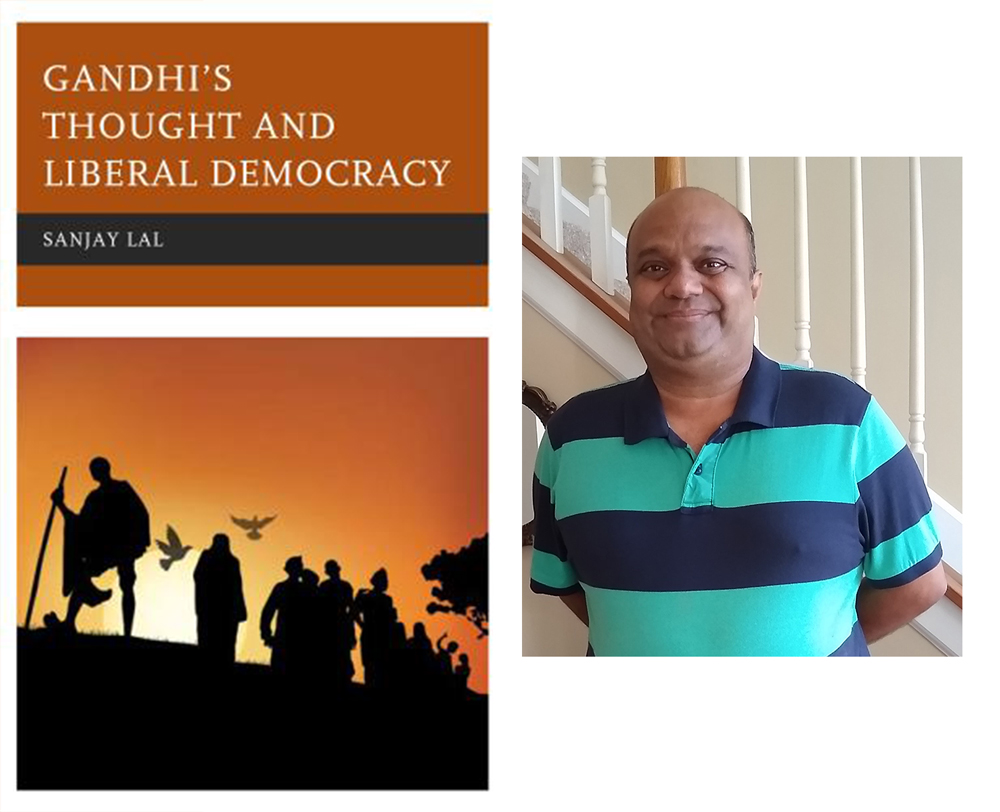
Acorn Editor Sanjay Lal Talks about his Book on Gandhi’s Political Philosophy

In Gandhi’s Thought and Liberal Democracy (Lexington Books, 2019), Sanjay Lal makes the case that for Gandhi, in stark contrast to commonly accepted liberal orthodoxy, religion is indispensable to the public life, and indeed the official activity, of any genuinely liberal society. Gandhi scholars, political theorists, and activist members of a lay audience alike will all find much to digest, comment upon, and be motivated by in this work.

Listen to the podcast at New Books in Hindu Studies, a channel of New Books Network

‘Somebodiness’ in Restorative Justice

Editors of The Acorn present work for the 2020 online conference of the Peace and Justice Studies Association

“Vulnerabilities of Somebodiness in Restorative Justice Theory”

  • Anthony Neal (Mississippi State University)
  • Greg Moses (Texas State University)
  • Sanjay Lal (Clayton State University)